PA-PE+(s) 7. -Design?-
When we talk about good design, we often assume it is the one that should prevail: the one that naturally imposes itself over the rest, for example through the 10 principles of good design by Dieter Rams. But this idea is based on a questionable assumption: that good design can be applied as a norm in the real world.
The problem is that design never occurs under ideal conditions. It is shaped by budgets, time, hierarchies, economic interests, cultural contexts, and technical limitations. These factors alter the original intention of the design. In this environment, what is often sought is not the best possible design, but the most viable or profitable one. Establishing universal principles of good design may seem necessary, but in the long run it becomes counterproductive. Over time, these principles become outdated and end up turning into dogmas that are repeated without the original context that justified them. What was meant to be a guide becomes a doctrine. But without limits or direction, another problem emerges. If everything is relative, the possibility of distinguishing between good and bad design disappears. The concept dissolves, and criteria fragment. Here lies the paradox: good design needs to exist as a reference, yet this reference is unreal. The more it is defined, the further it moves away from the real world. The closer it gets to reality, the more it loses its ideal condition.
Perhaps the defeat of good design is not its disappearance, but its very definition. In attempting to establish it as a norm, it becomes a utopia: an idealized model that cannot exist under the real conditions of design. This opens an uncomfortable void. If good design is unreal, how should one design? Without this reference, design loses a clear direction and fragments into multiple individual criteria.
Perhaps the defeat of good design is not that it does not exist, but that it cannot exist.
And yet, design will continue. And bad design will too.
— Provocation by Nissu Vayreda
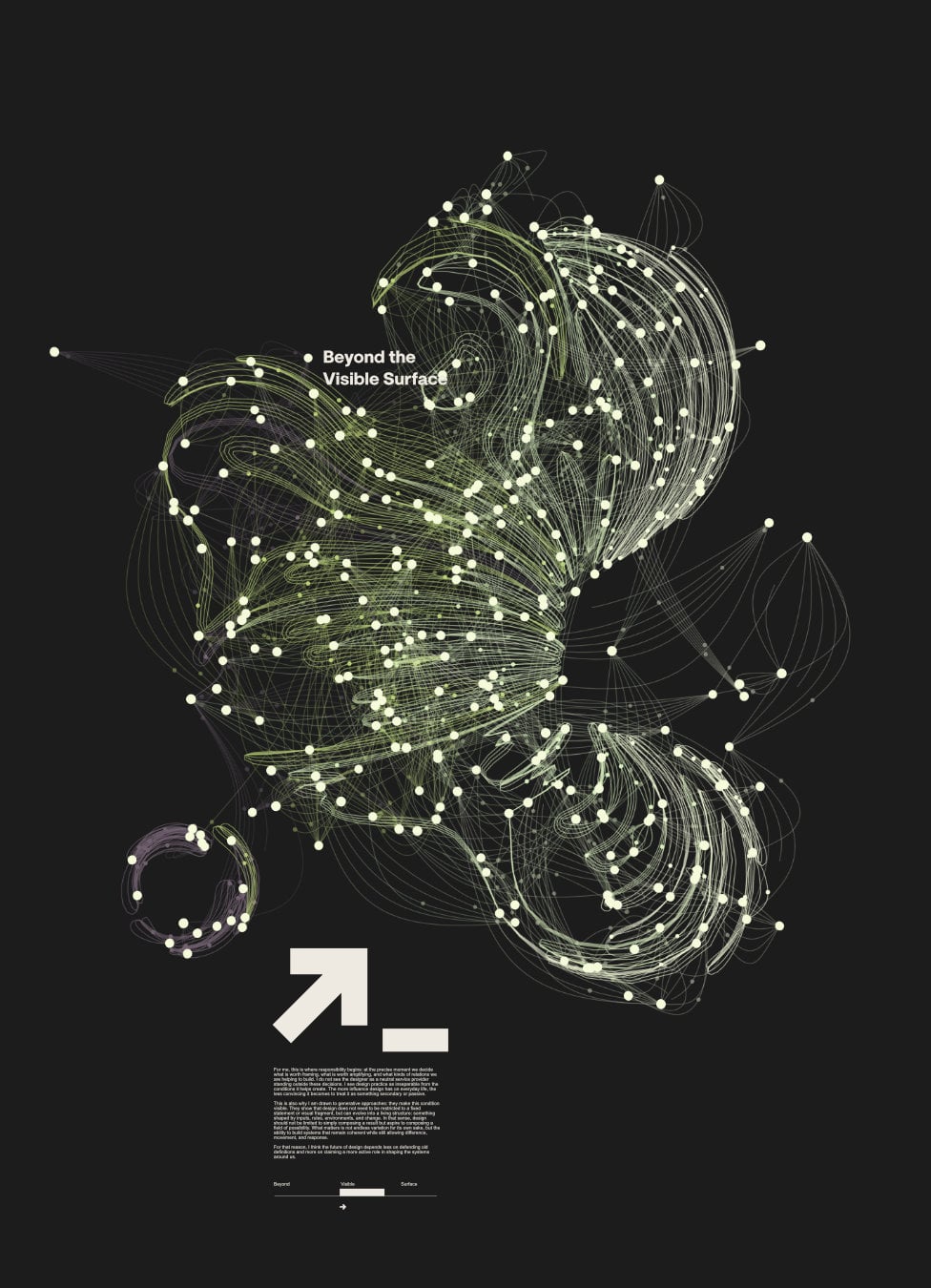
The Defeat of Good Design
Looking beyond the surface to the systems design serves
Essay by Patrik Hübner, May 2026
In 1968, German mathematician, philosopher, and academic Georg Nees made a picture out of a system slowly losing control. At first glance, Schotter is almost painfully simple: a grid of small squares, arranged in neat rows. At the top, everything behaves. The squares sit where they are supposed to sit. They follow the order that has been given to them. But as the image moves downward, the system begins to drift. The squares rotate, slip, and fall out of alignment. What starts as a clean structure becomes a field of disturbance. The strange thing is that the image seems to becomes more interesting as it becomes less perfect. You could argue that this is not because order disappears but rather because order remains visible while losing its certainty. The grid is still there, but it no longer controls everything. The work seems to ask how much disturbance a structure can absorb before it becomes something else.
That question feels surprisingly close to the field of design because it points to a conflict that sits at the center of almost every discussion about quality. On the one hand, we need structure. Without principles, references, methods, or shared criteria, it becomes almost impossible to compare ideas, defend decisions, or explain why one solution feels more careful than another. On the other hand, design only becomes real once the structure begins to meet resistance: when an idea has to survive production, interpretation, use, and all the small distortions that come with becoming part of the world. The idea may still be there, but it no longer controls everything. Like the grid in Schotter, it remains visible while being pushed out of certainty. This is why a design cannot be understood in isolation. Reality does not simply surround a design like context around an object; it becomes part of the design’s meaning, sometimes more decisively than the intention that started it. And I feel it is important to recognize that this instability is not a side effect of design, but one of its fundamental materials.
You could argue that a chair is never only a chair. It is also a production method, a price, a material choice, a repair problem, a domestic habit, and eventually perhaps waste. An interface is never only an interface. It is also a business model, a data structure, a behavioral script, and a decision about what should become easy or difficult. And likewise, a brand is never only a brand. It is also a promise, a mask, a strategy, and sometimes a way of making contradictions easier to accept. Seen this way, design is not simply the object that appears at the end. It is the temporary stabilization of many forces.
Rules for Beauty
This is where the language of good design begins to mislead us: it speaks as if quality were located in the thing itself, while practice keeps showing that quality is distributed across relations, decisions, and consequences. The closer we look, the harder it becomes to separate the quality of a thing from the system that produced it and the system it continues to serve. This is where the early history of computer-based art offers insight and some form of precedent: in the middle of the twentieth century, artists, mathematicians, philosophers, and engineers began asking whether aesthetic decisions could be translated into operations. Could an image be made not by composing every detail directly, but by defining a system that would generate it? Could form emerge from rules, probability, parameters, and signs? This line of thinking became known as generative aesthetics. The term belongs to a specific history of (computer) art, but the fundamental question behind it reaches way beyond the boundaries of this field. It asks whether something as uncertain as aesthetic experience can be approached through structure. In doing so, we are asked to look less at the finished work itself and more at the process that brings it into being.
Max Bense was central to this shift. His thinking suggested that aesthetic states could be produced through operations applied to material elements that function as signs. Beauty, or at least aesthetic order, was no longer treated only as a mysterious quality of the finished object.
It could be approached through information, distribution, probability, and process. Reading his work and thoughts through a lens of a creative who addresses these same questions 60 years later, I find a form of futuristic optimism in his approach: Bense imagined that aesthetic judgment might become less dependent on taste alone. More describable. More systematic. Perhaps even repeatable. But an even more interesting line of though emerges when we consider what happens when this rule-based, mathematic perspective reaches its limits. A rule can produce order, but it cannot guarantee meaning. A system can create variation, but not necessarily relevance. A structure can make decisions repeatable, but it cannot decide whether those decisions still matter under changing conditions.
Referencing Georg Nees’ Schotter feels especially powerful in this regard because it does not hide this problem. It shows its own rules under increasing pressure: the grid remains visible, but its authority is weakened by deviation. The image lives in the moment where order and disturbance begin to depend on each other. To me, this is a more powerful metaphor for design quality than the fantasy of a perfect principle. Quality does not magically appear because a rule has been followed. It appears (if it appears at all, that is) in the negotiation between what a rule can make possible and what a situation demands.
The Surface may be correct
Frieder Nake’s Hommage à Paul Klee brings another layer of this problem into view. The work uses computational processes to generate drawings that recall the visual language of Paul Klee. But the system does not simply copy Klee. It creates a field of possible images shaped by rules, chance, and computation. The result could resemble a known artistic language without being identical to it. That distinction matters: a surface can resemble something without sharing its substance. Design has reached a point where this distinction is becoming harder to ignore. Many of the signs we associate with good design, not least through the long influence of Dieter Rams’ ten principles, are widely available today: restraint, clarity, reduction, calmness, precision, generous spacing, well-behaved typography, sustainable-looking packaging, friendly interfaces. These qualities can still be meaningful. But they can also be reproduced without the thinking that once gave them force. A product can look restrained while depending on an irresponsible production model. A brand can speak in the language of care while avoiding the work that care would require. The surface may be correct, yet the underlying system could be utterly broken.
This is why good design cannot be judged only by what appears. It also has to be judged by what produces the appearance, what the appearance enables so to speak. In work based on generative thinking, the visible form is only one layer. Underneath that layer you find rules, operations, decisions, constraints, and forms of autonomy.
I would argue that all forms of design need this same shift in attention: away from the surface alone and toward the conditions that make the surface possible. Not only: does it look clear? But: what does this clarity serve (and: what does it hide)? This becomes especially visible when design moves from fixed outcomes to systems of variation.
In 2017, Nutella released seven million different jar designs in Italy. No two labels were the same. The project seemed to capture something essential about contemporary design: a mass-produced object could suddenly appear individual. A supermarket shelf could become a field of variation. Behind the cheerful surface was an algorithm generating difference at industrial scale. It is a beautiful example, but also a revealing one. Because once variation becomes easy, it becomes harder to know what kind of difference actually matters. Seven million labels can be unique without changing the product, the company, the shelf, the desire, or the logic of consumption around them. The jar becomes different, but the system remains the same. That certainly does not make the project meaningless but it does reveal something important about the present condition of design: we have become very good at generating difference on the surface. But difference itself is not yet meaning. A system can produce countless outcomes without changing the deeper conditions in which those outcomes operate.
This is one of the traps of generative and rule-based creative work when it is reduced to all but output: a living design system is not valuable because it produces many versions. It becomes valuable when variation creates relation — to a place, a story, a behavior, an environment, or a question that could not have been expressed just as clearly through one fixed form. Otherwise, variation becomes simply decoration at scale.
When Bad Design looks good
Good design has its own version of this problem: a design can become more refined, more flexible, more consistent, more usable, and still leave the underlying logic untouched. It can improve the interface of a questionable system. It can make consumption feel more thoughtful. It can make extraction feel more elegant. It can make speed feel like care. This is where bad design becomes hardest to recognize. It does not always arrive as ugliness, confusion, or incompetence. Sometimes it arrives as clarity or even in an efficient, seamless form. Sometimes it arrives as exactly the kind of surface we have learned to trust. The defeat of good design might begin exactly here: when its language can be used fluently by systems that do not share its values.
By looking at AARON, Harold Cohen’s early AI art system, the questions we ponder move one layer deeper: from what a system produces to where authorship actually sits. Developed from the early 1970s onward, AARON was one of the first major AI art systems: a rule-based program that could produce drawings and paintings without Cohen composing each image directly. It was not AI in the contemporary sense of large datasets and machine-learning based statistical prediction. It belonged to an earlier symbolic tradition, where intelligence was approached through explicit rules, procedures, and internal models of how drawing might work. Cohen was not asking the machine to imitate an existing style from a dataset. He was trying to encode a way of making images. This makes AARON interesting beyond the history of computer art. The program did not remove the artist from the process; it changed where the artist acted. Cohen’s authorship moved away from the direct making of each individual image and into the construction of the system that made images possible. He was still making aesthetic decisions, but many of those decisions now lived inside rules, constraints, and procedures that could continue to operate without his hand.
This is where AARON stops being a historical example and becomes a mirror for contemporary design: designers are no longer only shaping individual objects, posters, products, or interfaces. They define frameworks, identities, prompts, datasets, interaction logics, brand systems, and automated processes. They create conditions under which many future decisions will be made, often by people or machines far removed from the original designer. In this sense, the designer’s responsibility does not end with the visible result. It extends into the logic that keeps producing results after the first one has disappeared. This makes the question of quality more complex. If a designer creates a system, then the designer also participates in defining what that system makes accessible, what it makes difficult, what it rewards, and what it normalizes: a system designed for conversion produces different realities than a system designed for understanding. A system designed for speed produces different realities than a system designed for care. A system designed for endless variation produces different realities than a system designed for lasting relation.
In this conversation about good design and the role of creatives, this perspective feels especially relevant to me, now that machine-learning and generative systems increasingly shape what creative work looks like, how it is produced, and where authorship begins. When almost anything can be made to look professional, and tools can generate polished surfaces in seconds, sheer production and output is no longer enough. When templates absorb decisions that once belonged to designers, the real work moves deeper into judgment. This is, by no means, a comfortable position. It does not allow design to hide behind static principles anymore and forces creatives to very clearly argue and defend what their work and profession is truly about. Without some kind of compass and the presence of human taste, design risks becoming fluent in the logic of the systems around it: optimizing what can be counted, smoothing what should perhaps remain difficult, and slowly losing the ability to argue for qualities that do not immediately prove themselves as performance. This kind of self-referential work becomes dangerous when it becomes too certain. A principle that once helped designers see more clearly can eventually become a visual habit: repeated because it is recognized, accepted because it feels professional, and carried forward long after the conditions that gave it urgency have changed.
Principles as Questions
A principle becomes useful only when it forces the next question. Simplicity only becomes meaningful when it reveals the structure of a situation instead of flattening it. Honesty only becomes meaningful when we ask what the design reveals and what it keeps hidden. This changes what we are actually judging. The question is no longer whether an object matches an idea of good design, but whether the relations around it still support the claim that it is good. And of course, that agreement is never pure. There will always be compromise. But compromise is not the enemy of design. Some compromises make a design more precise because they force it to respond to real conditions. Others hollow it out until only the appearance remains. The difficult task is learning to tell the difference.
This is why Schotter remains such a useful image in the context of this discussion. The work would not function without order. But it would also not function without disturbance. Its force lies in the moment where a structure begins to lose certainty without collapsing completely. The grid is still there, but it no longer controls everything. The disturbance is visible, but it has not become chaos.
Maybe this is where good design becomes possible: not as the cleanest solution, but as the most conscious one. A good design decision is not necessarily the one that avoids compromise, but the one that understands what the compromise changes. It knows what has been simplified, what has been amplified, what has been hidden, and what has been made easier. It does not pretend to stand outside the system it serves. It asks what the system is asking from it, and whether that request should be fulfilled, resisted, or transformed.
This might sound less heroic than the idea of good design as a timeless ideal, but it is probably closer to the reality of design work. In practice, the decisive moment is often not the manifesto or the perfectly argued principle, but the smaller decision inside the project: the metric we refuse to optimize for, the shortcut we do not take, the complexity we decide to keep visible, the sentence we fight to keep understandable, or the friction we leave in place because removing it would make the wrong thing too easy. These decisions rarely look like grand statements. But they are often where the quality of a design is actually negotiated.
Good design, then, is not something a system can simply output. It has to be negotiated inside the very conditions that make it fragile: the business model, the material choice, the interface logic, the metric, the compromise, the intended behavior, and the meaning the work claims to create. And perhaps that makes it more fragile than a norm, but also more alive. Good design is not a doctrine waiting to be applied but rather a practice of judgment that has to be renewed from one situation to the next.
Design will evolve. Generative systems will get better at generating images, interfaces, identities, variations, and experiences. Many of them will look convincing. Many will perform well. Some will even look exactly like good design. The harder task is to make work that can survive the question: good for what, and why does it matter?