Systems Thinking describes a holistic[1] approach to understand and address complex challenges by recognizing and analyzing the interconnectedness and interdependencies among elements and phenomena of the environment. It is a core creative strategy that enables data-drivengenerative design in a process of co-creation between designer and machine and can, among a multitude of expressions, be used to enable dynamic brand identites.
Systems Thinking is focused on identifying and understanding patterns, relationships, and dynamics that govern the behavior of a whole system, rather than just its individual components. It involves capturing, recognizing and anticipating how systemic ideas are expressed as either data or patterns and how they can be leveraged to create adaptive and efficient designs by expressing them as rules and programs. Used within the context of branding, it allows for the transformation of data into meaningful stories and autonomous design systems that surface systemic properties of different market segments and environmental contexts as symbols or form. Applying Systems Thinking to communications design and branding enables the development of solutions that are not only meaningful and innovative but also responsive to the complexities of the modern world, where technology, society, and the environment are deeply intertwined.
Map of relevant entites and relationships
{
“nodes”: [
{ “id”: 1, “label”: “Systems Thinking”, “title”: “An approach to understanding complex systems by viewing them as wholes, not just as individual parts.” },
{ “id”: 2, “label”: “Generative Design”, “title”: “A design method that uses algorithms and computational processes to generate designs.” },
{ “id”: 3, “label”: “Storytelling”, “title”: “The art of conveying stories, messages, or information through narrative.” },
{ “id”: 4, “label”: “Feedback Loops”, “title”: “Processes where the outputs of a system are circled back as inputs, influencing the system.” },
{ “id”: 5, “label”: “Systemic Design”, “title”: “An interdisciplinary field that integrates systems thinking and design methodology.” },
{ “id”: 6, “label”: “Emergent Behavior”, “title”: “Complex patterns and behaviors that arise from simple interactions within a system.” },
{ “id”: 7, “label”: “Algorithmic Methods”, “title”: “Techniques and processes derived from algorithms, especially in problem-solving and design.” },
{ “id”: 8, “label”: “Future Narratives”, “title”: “Innovative storytelling techniques that explore and envision future possibilities and scenarios.” },
{ “id”: 9, “label”: “Interactivity”, “title”: “The degree to which users can participate in modifying the form and content of a mediated environment.” },
{ “id”: 10, “label”: “Adaptive Systems”, “title”: “Systems that can adjust and change in response to external conditions.” },
{ “id”: 11, “label”: “Data”, “title”: “Quantitative or qualitative values, often used for analysis and decision-making.” },
{ “id”: 12, “label”: “Algorithms”, “title”: “A set of rules or processes for solving problems, especially with computers.” },
{ “id”: 13, “label”: “Programmatic Design”, “title”: “Design methodology that utilizes programming for automation and efficiency.” },
{ “id”: 14, “label”: “Environment”, “title”: “The natural world, as a whole or in a particular geographical area, especially as affected by human activity.” },
{ “id”: 15, “label”: “Co-creation”, “title”: “A collaborative process of producing something jointly, often involving diverse stakeholders.” },
{ “id”: 16, “label”: “Patterns”, “title”: “Recurring forms or models that can be observed in various systems or designs.” },
{ “id”: 17, “label”: “Relationships”, “title”: “The ways in which two or more concepts, objects, or people are connected.” }
],
“edges”: [
{ “from”: 1, “to”: 4, “arrows”: “to”, “label”: “Influences” },
{ “from”: 1, “to”: 5, “arrows”: “to”, “label”: “Integrates with” },
{ “from”: 1, “to”: 6, “arrows”: “to”, “label”: “Leads to” },
{ “from”: 2, “to”: 7, “arrows”: “to”, “label”: “Utilizes” },
{ “from”: 2, “to”: 10, “arrows”: “to”, “label”: “Incorporates” },
{ “from”: 2, “to”: 13, “arrows”: “to”, “label”: “Employs” },
{ “from”: 3, “to”: 8, “arrows”: “to”, “label”: “Builds on” },
{ “from”: 3, “to”: 9, “arrows”: “to”, “label”: “Enhances” },
{ “from”: 1, “to”: 2, “arrows”: “to”, “label”: “Informs” },
{ “from”: 2, “to”: 3, “arrows”: “to”, “label”: “Contributes to” },
{ “from”: 2, “to”: 11, “arrows”: “to”, “label”: “Relies on” },
{ “from”: 11, “to”: 12, “arrows”: “to”, “label”: “Drives” },
{ “from”: 12, “to”: 7, “arrows”: “to”, “label”: “Forms basis of” },
{ “from”: 7, “to”: 13, “arrows”: “to”, “label”: “Applied in” },
{ “from”: 13, “to”: 14, “arrows”: “to”, “label”: “Interacts with” },
{ “from”: 1, “to”: 14, “arrows”: “to”, “label”: “Considers” },
{ “from”: 3, “to”: 15, “arrows”: “to”, “label”: “Facilitates” },
{ “from”: 15, “to”: 2, “arrows”: “to”, “label”: “Influences” },
{ “from”: 1, “to”: 16, “arrows”: “to”, “label”: “Reveals” },
{ “from”: 16, “to”: 5, “arrows”: “to”, “label”: “Are used in” },
{ “from”: 6, “to”: 17, “arrows”: “to”, “label”: “Depends on” },
{ “from”: 17, “to”: 10, “arrows”: “to”, “label”: “Shapes” }
]
}
This map is interactive.
Hover over elements to learn more. Click-and-drag elements to move them around.
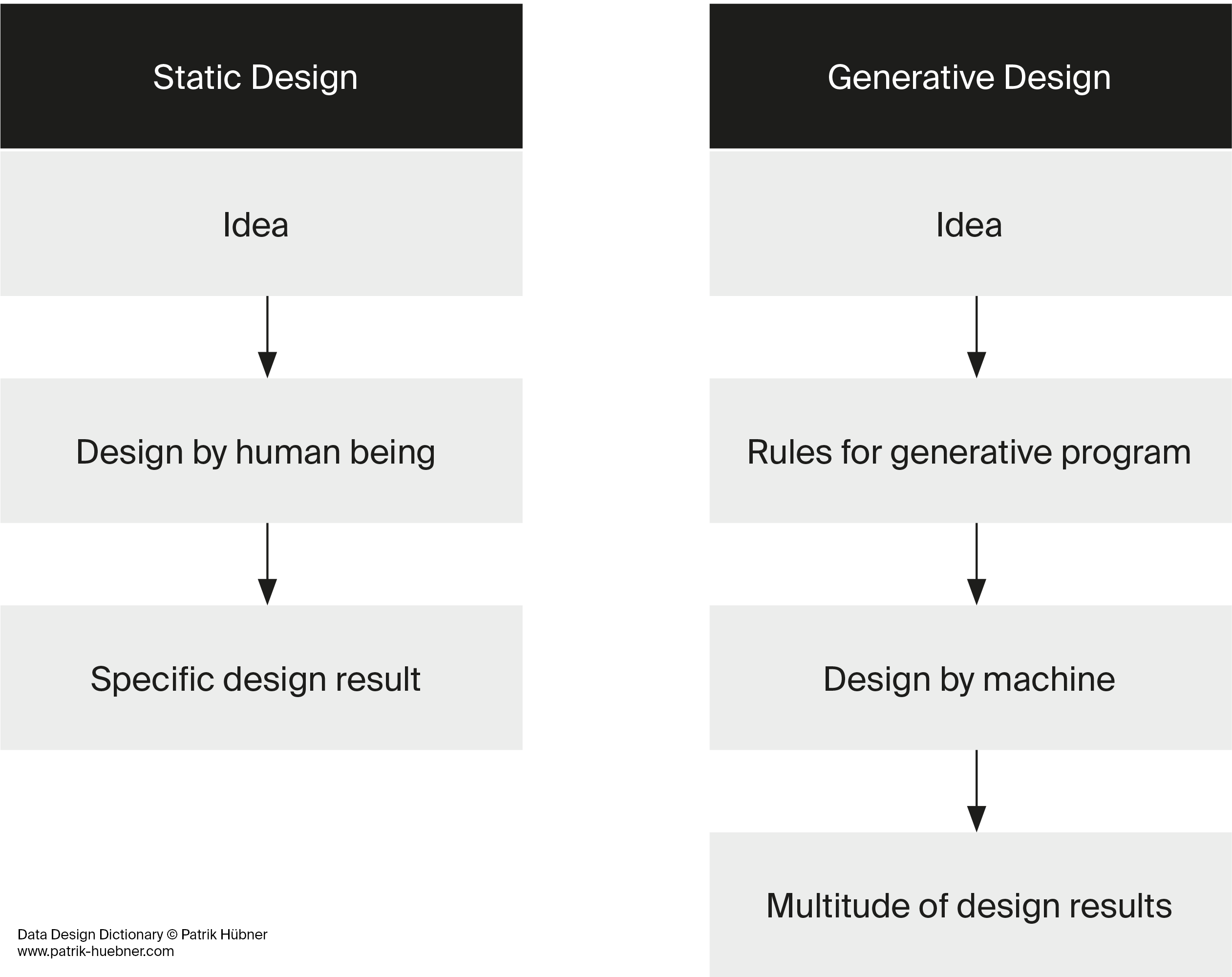
Generative design signifies a paradigm shift in design: Instead of working directly on a specific design result, generative designers take a different approach. They first deal with the idea in detail so that they can then describe and express it as a program. It is then the machine that uses this program to produce a variety of forms of the idea without the creative person having to intervene.
Additional quotes about systems thinking
„A system isn’t just any old collection of things. A ‘system’ is an interconnected set of elements that is coherently organized in a way that achieves something. If you look at that definition closely for a minute, you can see that a system must consist of three kinds of things: elements, interconnections, and a function or purpose.“[1]
“The development of systems is about converting subjective decisions into objective rules so that they can be shared with other people or automated with machines.”[2]