In the realm of generative design, Artificial Intelligence (AI) stands as both a tool and a co-creator, enriching the designer’s capacity to think and systematically interpret and access the narratives that the qualitative datasets of our environment hold. In this context, AI can be considered a specific tool that makes otherwise inaccessible qualitative datasets (e.g. the underlying sentiment encoded in a string of a text) available as inputs to machines and programmed design systems. This interpreted and transformed input can then be used to bring new perspectives and previously unavailable insights to the conversation between brands and their audiences. In the broader context of generative design, there is no use for a focus on AI crafting fragments of design in isolation but rather for using it to interpret the depth and dimensions of stories encoded in qualitative data that were previously outright inaccessible to more traditional algorithms. This very powerful process of turning qualitative data into machine-usable quantitative data is essential to influence generative design systems and allow designers to craft data-based rules as the driving force of dynamic brand identities and narratives.
Map of relevant entites and relationships
{
“nodes”: [
{“id”: 1, “label”: “Generative Design”, “title”: “A design philosophy that leverages computational processes to generate complex structures and forms.”},
{“id”: 2, “label”: “Artificial Intelligence (AI)”, “title”: “A broad field of computer science aimed at creating smart machines capable of performing tasks that typically require human intelligence.”},
{“id”: 3, “label”: “Qualitative Data”, “title”: “Non-numerical information that provides insights into patterns, narratives, and behaviors.”},
{“id”: 4, “label”: “Patterns & Insights”, “title”: “Discoveries made through the analysis of data that reveal underlying trends and themes.”},
{“id”: 8, “label”: “Brand Identities & Visuals”, “title”: “The visual and conceptual components that form a brand’s public perception.”},
{“id”: 9, “label”: “Machine Learning (ML)”, “title”: “A subset of AI focusing on the development of algorithms that improve automatically through experience.”},
{“id”: 10, “label”: “Brand Narratives & Identities”, “title”: “The stories and characteristics that define a brand’s essence and differentiate it in the market.”},
{“id”: 11, “label”: “Algorithms”, “title”: “Step-by-step computational procedures used for data processing and automated reasoning.”},
{“id”: 12, “label”: “Co-creation”, “title”: “A collaborative approach where brands and consumers work together in the creation process, enhancing innovation and relevance.”},
{“id”: 13, “label”: “Environment”, “title”: “The surrounding conditions and influences that affect the lifecycle and behavior of a system.”},
{“id”: 14, “label”: “Systemic Thinking”, “title”: “An approach to problem-solving that focuses on understanding and navigating the complexities of whole systems, rather than individual parts in isolation.”}
],
“edges”: [
{“from”: 2, “to”: 1, “label”: “enriches”, “arrows”: “to”},
{“from”: 3, “to”: 2, “label”: “analyzed by”, “arrows”: “to”},
{“from”: 3, “to”: 4, “label”: “reveals”, “arrows”: “to”},
{“from”: 4, “to”: 8, “label”: “inform”, “arrows”: “to”},
{“from”: 2, “to”: 10, “label”: “foundation for”, “arrows”: “to”},
{“from”: 9, “to”: 2, “label”: “subset of”, “arrows”: “to”},
{“from”: 11, “to”: 9, “label”: “used in”, “arrows”: “to”},
{“from”: 2, “to”: 12, “label”: “facilitates”, “arrows”: “to”},
{“from”: 2, “to”: 13, “label”: “operates within”, “arrows”: “to”},
{“from”: 2, “to”: 14, “label”: “employs”, “arrows”: “to”}
]
}
This map is interactive.
Hover over elements to learn more. Click-and-drag elements to move them around.
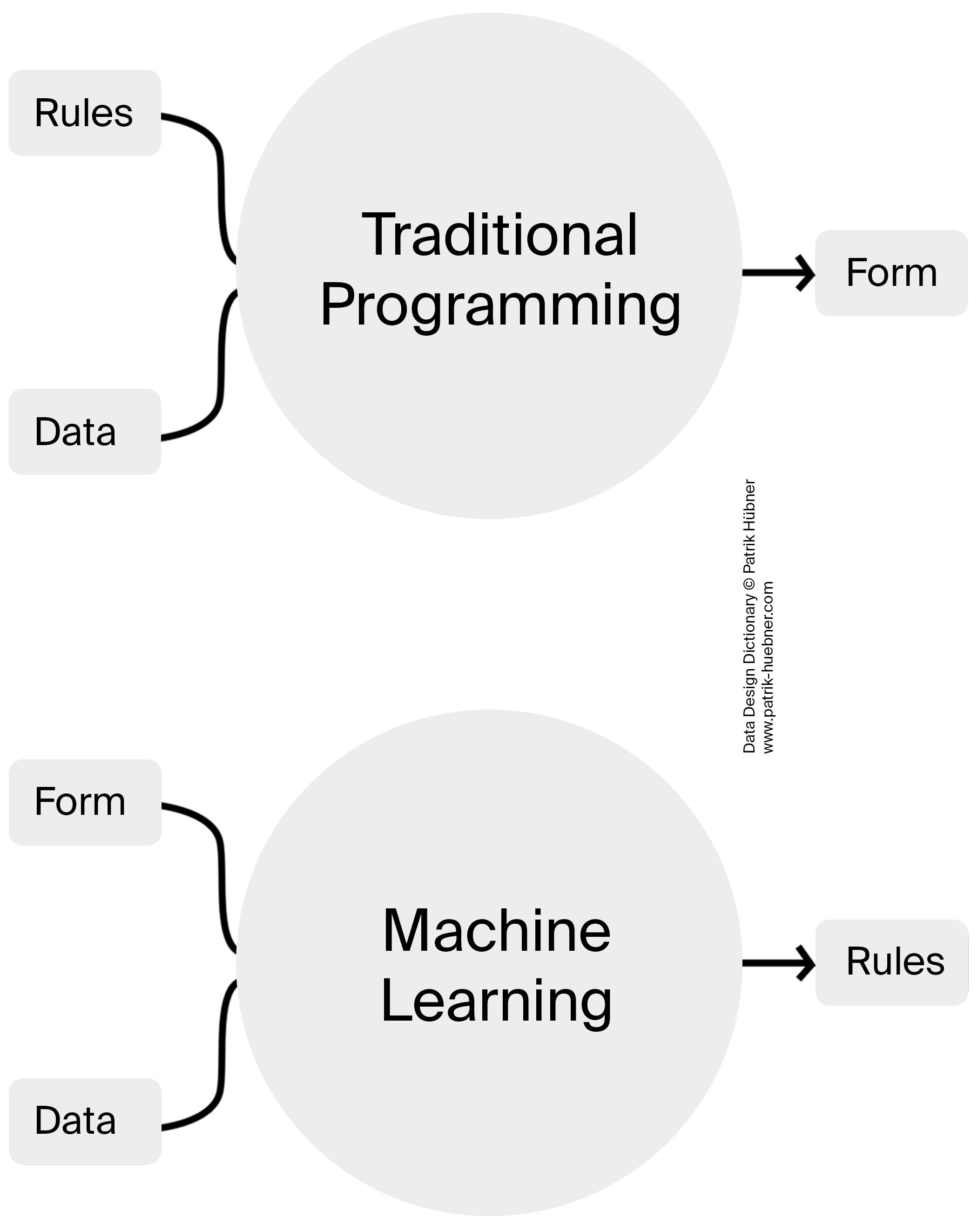
There is an actual difference between the publicly (over-)used term Artificial Intelligence (AI) and the field of Machine Learning (ML). AI describes the broader capability for machines to perform tasks in ways that could be considered “smart,” encompassing various current and future technologies. ML is more specific – a collection of strategies and methods where algorithms learn from data and for example form as input to extract rules, enabling it to generate outputs or make design decisions without being explicitly programmed for each case. This stands in contrast to traditional programming, which involves explicitly coding rules and feeding in data to produce specific outputs. In almost all cases in generative design, the more fitting term for the technologies and concepts used is thus ML rather than AI.
In traditional programming, developers input specific rules and data into a system to produce a desired array of form. Whereas in artificial intelligence, the algorithm uses data as well as form and its inherent structure to infer the rules itself.
The bigger picture of designing and branding with data: